Operation Veteran Assist In Alexandra
The last ten days have been a bit of a blur. Celia and I moved house from Preston to Monbulk, I spent four days near Alexandra with Operation Veteran Assist, and on Australia Day I had the great honour of receiving an Australia Day Medallion from the RSL and presented by my great mate, Drew Maddison. It is fair to say that life has been hectic.
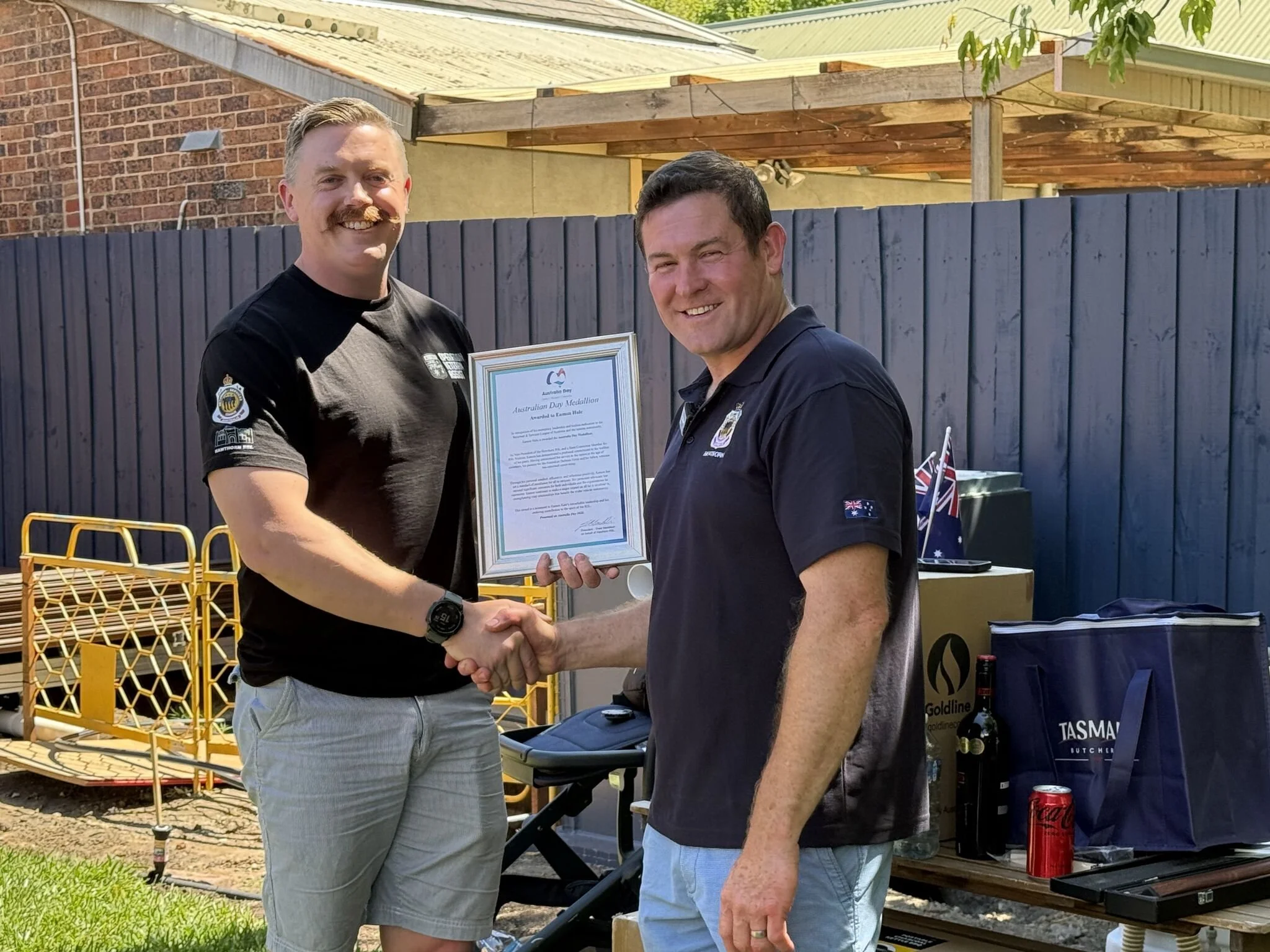
Drew presenting me with the Australia Day Medallion and certificate at Hawthorn RSL.
Operation Veteran Assist (OVA) has been extraordinary to witness up close. Fires across regional Victoria flared to their worst on 8 and 9 January, and by Sunday the 11th, while smoke still hung over paddocks and things were still burning, Drew was already coordinating a structured responseunder the OVA banner. His energy and intent was massively infectious. Veterans in the regions needed help, so he started moving to do it.
On the 17th, while Celia and I were buried in moving boxes, Drew, John Wilson, and the advance party were inducting thirty-two volunteers at the Seymour RSL, supervised by the RSL Victoria State President. Throughout the week, the numbers peaked at 37 volunteers, 35 of whom were veterans.
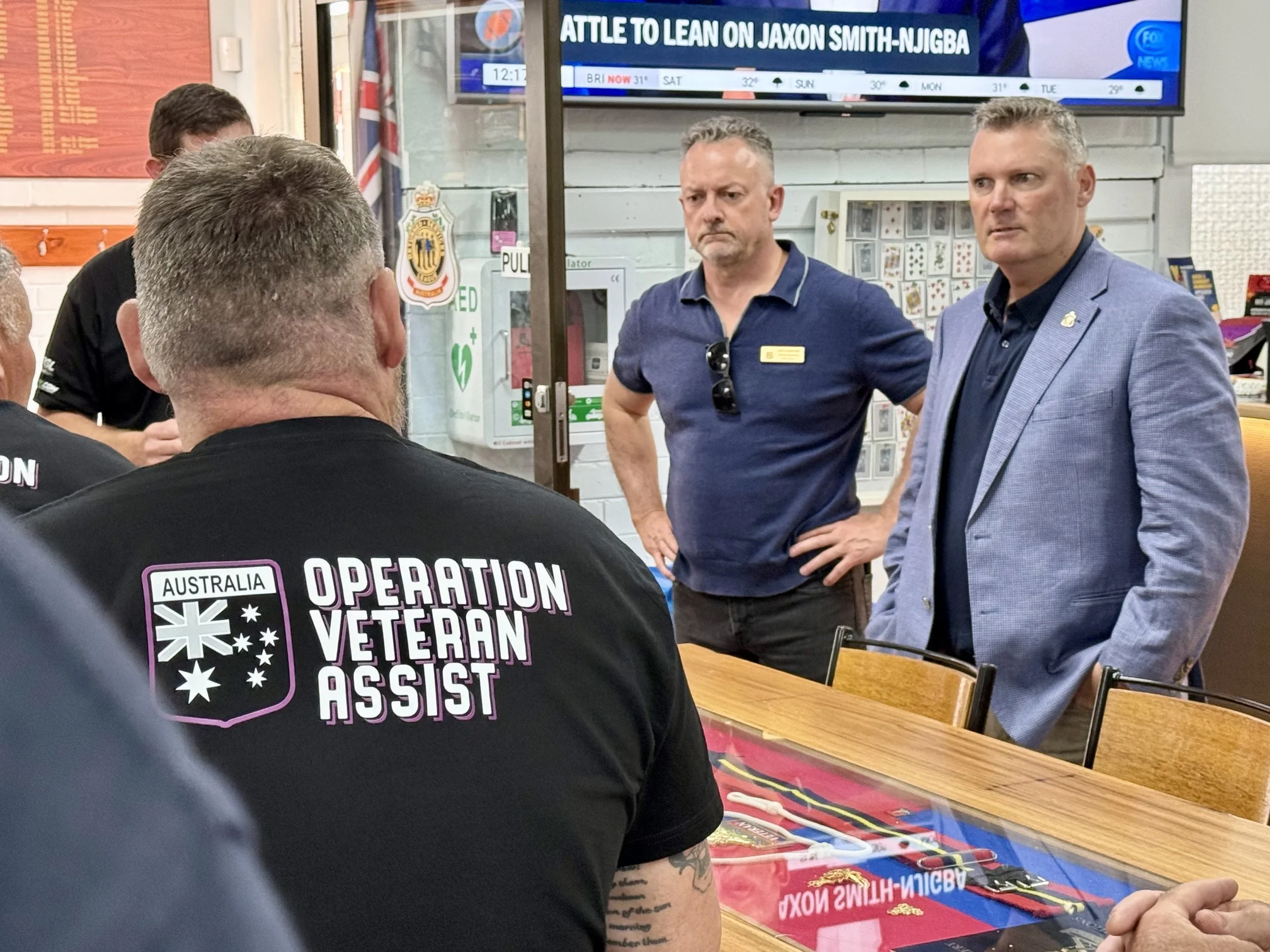
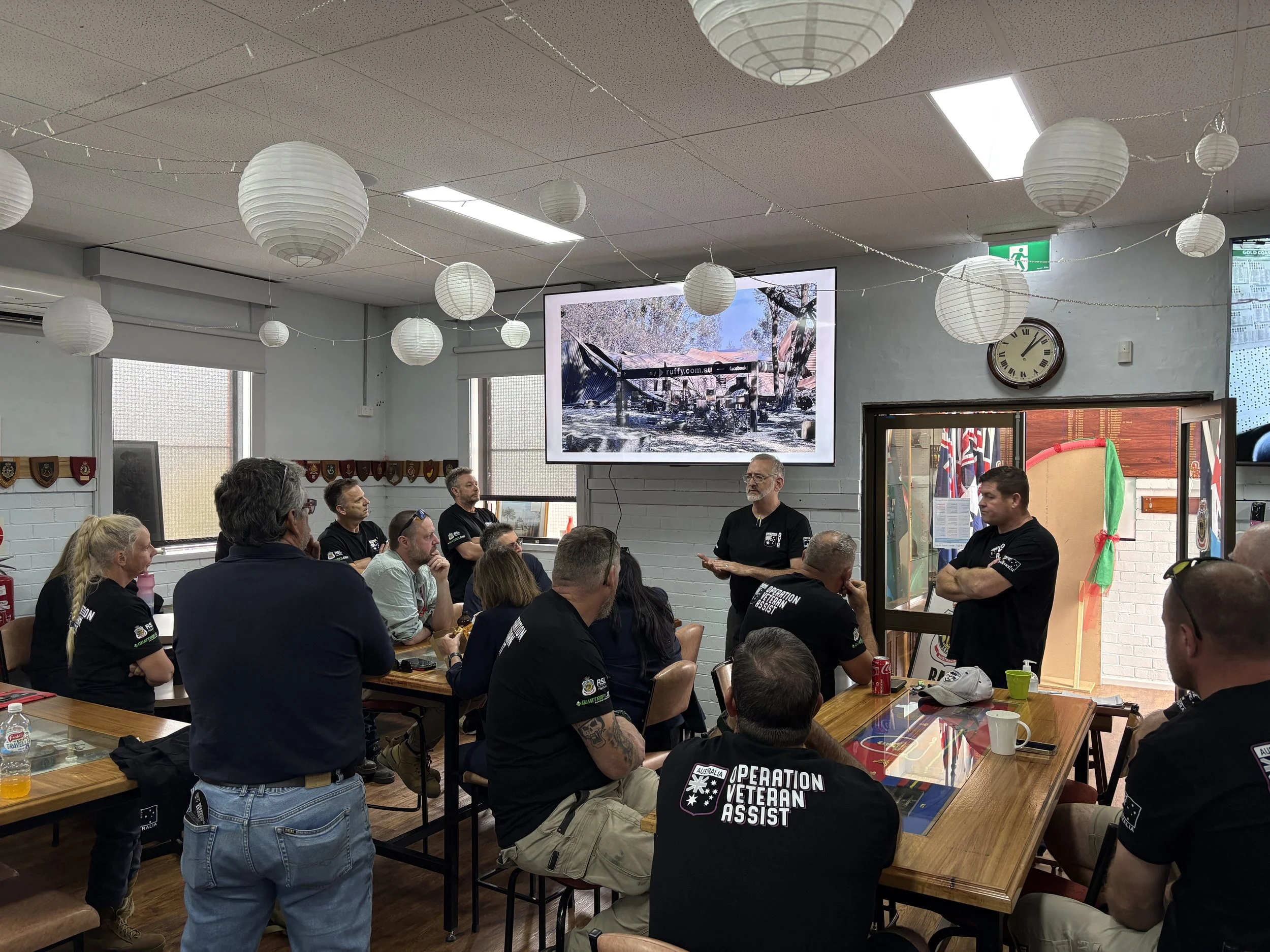
To create such an activity in six days is remarkable. What took shape was not something thrown together in haste. It was complex and detailed, safe and structured. Within a week of the worst of the fires, the team had identified veterans in need, scouted staging areas and potential campsites, drafted a charter, built a mission plan, and coordinated with police, the CFA, local community leaders, and a network of RSL sub-branches. Many people underestimate how quickly Drew can put a complex operation together. I know it shocked some when he pulled it off.
I missed the first two days but arrived in Alexandra early on the Monday. From the moment I stepped into the Alexandra RSL, I was stunned by what our volunteers had built. A proper staging area had been established in the back yard, centred around a mobile field kitchen loaned from Save Our Services Australia. It was a mega set-up, with six smoker ovens, two pull-out barbecues, four fridges, gas, running water, and awnings for shade. More impressive than the hardware was Leonie, a former Army Cook who produced three meals a day for up to thirty-five volunteers, RSL members, and local veterans. She became the quiet backbone of the whole effort, feeding the big rigs and lifting spirits. Local veterans wandered in not just for a meal but because it had become a safe space; welcoming and communal. Leonie did that and the vibe was veterans helping veterans.
Outside the Alexandra RSL, the team had split into two groups. Five volunteers were sent to Ruffy to assist on a veterans farm who had suffered serious burns while defending his property. The rest of the team were working around the tiny community of Fawcett, which, in terms of veteran density, must rival the Puckapunyal married patch! In a pocket of just a few streets, at least eight men and women had served. They just kept popping up and revealing themselves.
The mission itself was simple. Assist veterans, first responders, and their families with basic but vital recovery tasks. Repairing and tensioning fences. Cutting and clearing fallen trees that blocked tracks and compromised fences. Removing the wreckage of outbuildings. Shifting rubble and anything else that needed to be shifted. Work that wasn’t glamorous, but dirty and absolutely essential to people who had lost so much yet had so much to do. In Melbourne when your house burns down its devastating but no one expects you to get back into the gardening the next morning. For these folks, their sheds and houses were still smoking when they walked back out into the paddocks and got back to work. It’s a lot of pressure.
On the Monday we were at the property of Scottie. He’s a CFA volunteer, a farmer, and a soldier for thirty years. He barely stopped all day. We mostly saw him racing past in the CFA truck, heading off to help neighbours while his own paddocks still smouldered. He told us that when he found out we were veterans, he knew he could just leave and trust us to do the right thing. He also told us that what the guys achieved in a morning would have taken him months if not years to do. Many hands make light work, and a veteran with a chainsaw and enthusiasm is a powerful thing!
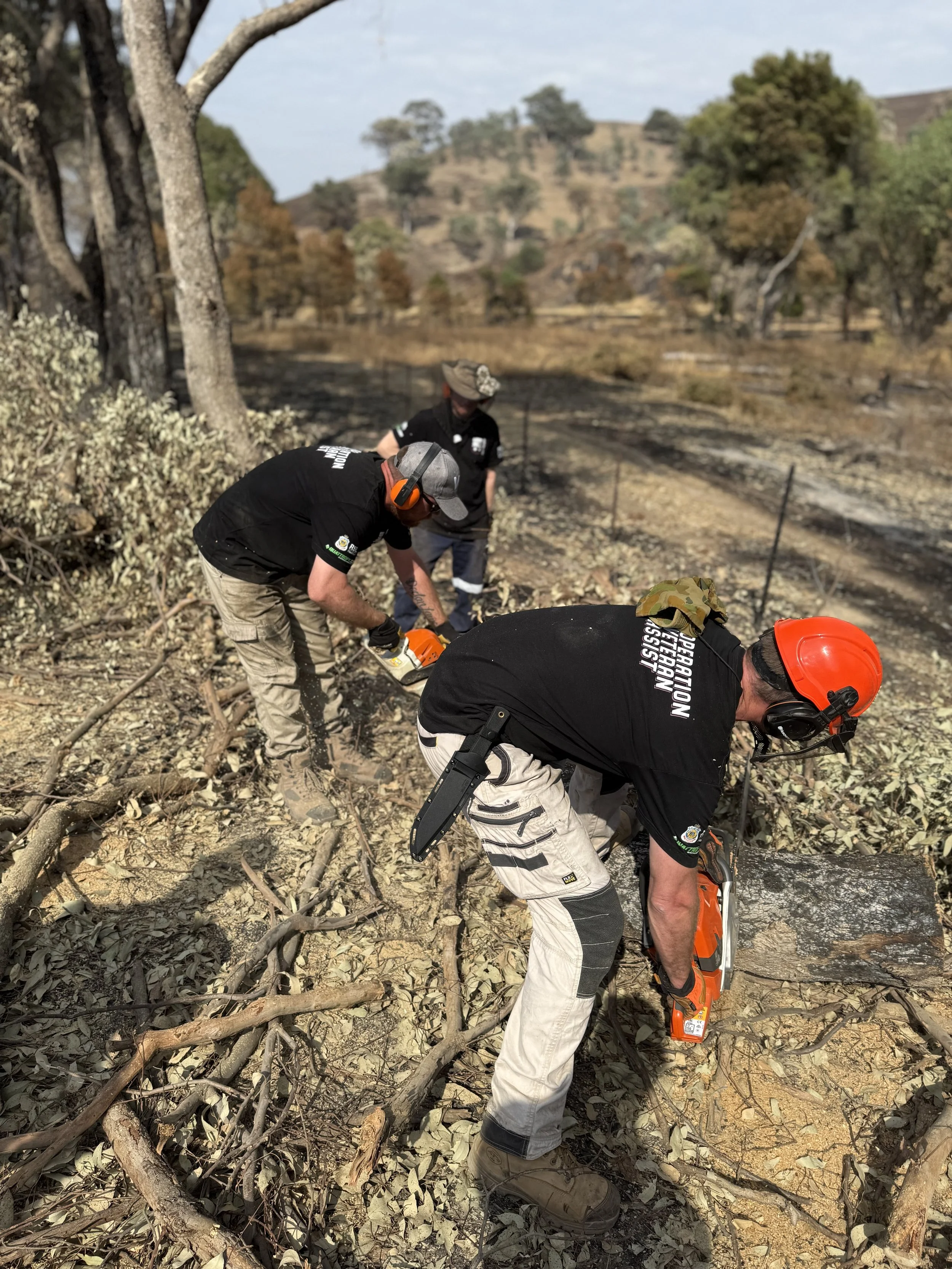
The guys cutting up a tree at Scotties property.
I was also really moved by the community itself. Fawcett was burned in strange patterns. A house would survive but every farm structure around it burned. A house would be burned but the hay shed next to it would survive. Half a fence would be burned to charcoal while the other half remained untouched. Vertical fence posts would be burned out but the wooden palings would still be there. An entire property could be burned black and white, with no colour in it left. Yet every few hundred metres there was a little or big Australian flag flying. People who had lost everything still had being Australian, and it really felt like it meant something. When they had lost everything else, they still had that.
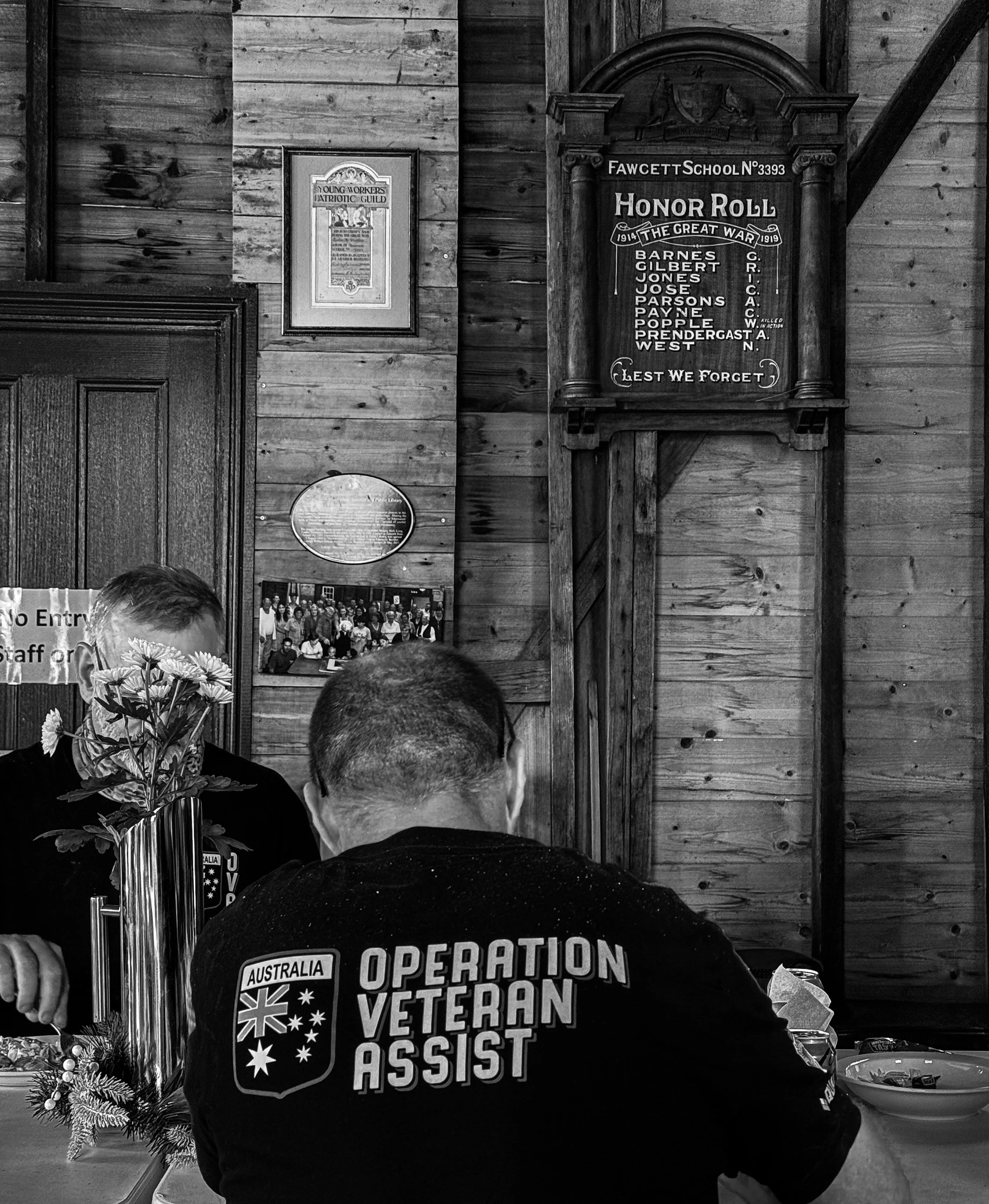
What it meant in practice was strangers helping strangers. Neighbours helping neighbours. A community that rallied in a way that felt old-fashioned in its decency but completely authentic and real. So close to Australia Day, it made me feel intensely proud of the Australian flag on my OVA shirt sleeve and that I would see fluttering in the wind outside a burned out farm. The tiny Fawcett Hall overflowed with donated food, tools, clothes, and essentials. People came only for what they truly needed, not what they fancied. They were humble, proud, and community-minded. It was Australia as we like to believe it should be.
We were asked once why we were there, and Christian told the person, “Because we’re Australians. We love our country, we’ve served our country, and we want to help other Australians”.
Meanwhile, up in Ruffy, the work was really tough but morale remained excellent thanks to their team leader, Tracey. A former Queensland police officer, a serving RAAF Reservist, and the owner of an earthmoving business, “The Digging Diva” worked in pink hi-vis and operated a bright pink Pozi-Track. Her team cleared almost two kilometres of fallen trees and collapsed fencing in rough terrain. I loved that Tracey was the boss, drove her team hard, but built up a really tight bond in just a few days. Leadership comes in many forms, and hers was exactly what we were all used to from the ADF. It was outstanding.
A pattern repeated across the week. We met veterans, listened to what they needed, rocked up a day or so later, and got it done.
Craig was one of my favourites. His son Sean, a CFA volunteer in the truck, saw us one afternoon as we were chopping up a tree, and mentioned that his dad had served in the Army as a Combat Engineer. When we arrived to check in, Craig apologetically and shyly pointed out a massive gum tree lying across one of his fences. Don’t worry, he said, he and his son would sort it. Sean not so quietly pointed out that his dad couldn’t lift a chainsaw and it’d take forever. So, the next morning ten OVA volunteers arrived, four chainsaws started roaring, the log piles grew, star pickets were straightened, the fence fixed, and in an hour and a half the job was done. Later I learned that Craig’s son-in-law is a mate of mine still serving at Puckapunyal. Australia is a big country but the veteran community is pretty small
While we stood around the remains of the tree, one of the volunteers told me, “I had no idea you guys existed. I’ve never done anything RSL related before, but I’ve found my tribe here”. We weren’t just helping Craig, we were helping ourselves too.
To say I was proud of the team does not capture the immense feelings I’ve got from it. I was humbled, inspired, and motivated by them. These men and women gave up holidays, time with their families, and in some cases took leave from work, all to help veterans they had never met but are part of the same tribe. Men and women who had worn the uniform, served their country, and now needed a hand. And when they needed it, volunteers from across Victoria turned up. Whether they were on the chainsaws, lifting sheets of corrugated iron, cooking meals, or handing out water bottles, every contribution mattered. Everyone was united in the mission.
Each night I went to my swag in the carpark of the footy oval with a massive sense of fulfilment. As a team, we’d done something that genuinely mattered. We’d done something positive and made someone’s life a little bit better. The conditions weren’t perfect, and the work was hard, but in that little bit of hardship I was reminded of why service bonds us so strongly, and why we slip back so easily into these type of roles.
In a landscape marked by so much fire damage and loss, I got to see the very best of Australians. I got to see people who’d give the shirt off their back if they thought it would help you.
It was a beautiful and extraordinary experience, and I could not be prouder to have been part of it.